JEPA-Anything Uses One Recipe to Model Seven Different Worlds
Researchers build a domain-agnostic world model that works across vision, biology, medicine, physics, and weather without redesigning for each field.
One Model, Seven Worlds
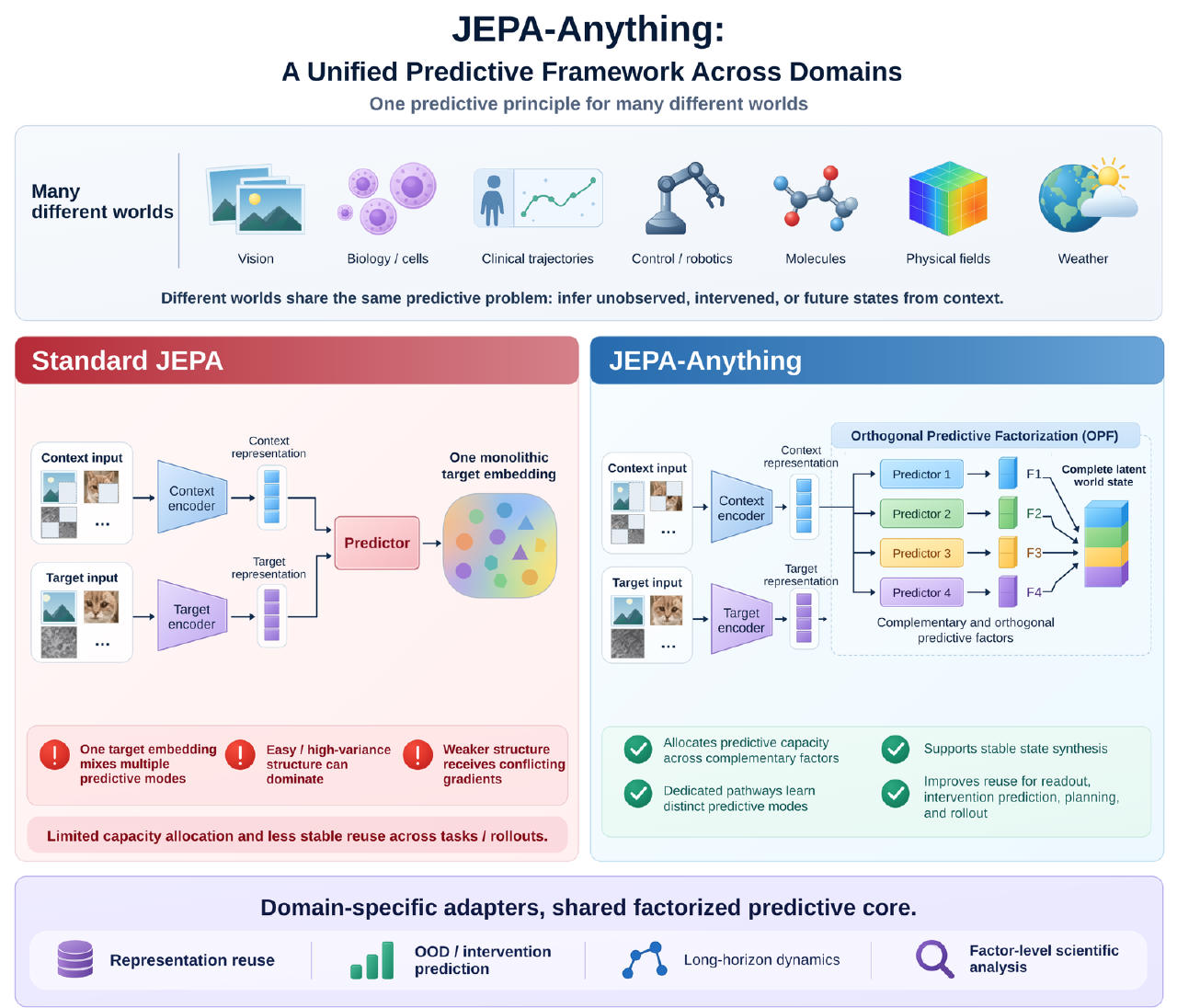
A team of researchers from PhAI Labs, CUHK, Fudan, Stanford, Oxford and Princeton has released JEPA-Anything, a framework that learns predictive models across seven wildly different fields using a single shared recipe.
The idea behind world models — AIs that predict how the world changes over time — has traditionally been domain-specific. You might train one model for video, another for robotics, and yet another for molecular simulations. JEPA-Anything skips that. It applies the same core method to vision, biology, clinical trajectories, control, molecular dynamics, physical fields and weather.
The team credits this flexibility to a technique called Orthogonal Predictive Factorization, or OPF, which they say solves a key weakness in standard [JEPA] systems.
The Factorization Fix
A standard JEPA, such as I-JEPA or V-JEPA 2, predicts a single unified target. The researchers call this a capacity-allocation problem: high-variance features dominate while weaker modes receive conflicting training signals. In practice, this means the model becomes good at predicting some things but poor at others.
OPF solves this by splitting the latent target into K separate subspaces — most experiments use four — each with its own dedicated predictor. After prediction, the factors are recombined mathematically to form a complete latent state. Three built-in rules keep each factor useful and prevent them from overlapping.
On a test called CITRIS Interventional Pong, the orthogonal version of the model achieved a condition number near 1.0, compared to 438.52 for a capacity-matched non-orthogonal model. That means the factors stayed cleanly separate during training.
Results Across Domains
JEPA-Anything improved reported metrics on all ten matched dynamics tasks tested. On Interventional Pong, single-intervention prediction error fell by about 35 percent. On the Burgers equation benchmark, six-step rollout error dropped roughly 45 percent [source 1]. In molecular dynamics, the model achieved the lowest one-step and 100-step errors across four substances including water and benzene.
Beyond pure prediction, the system has produced unexpected scientific insights. When analyzing single-cell biological data, a factor-nominated combination of IL-18 and CD73 blockade was later confirmed through wet-lab experiments in cell cultures, patient-derived organoids, tumor fragments and mice. The model also recovered Kepler's law of planetary motion from latent orbital patterns, with a fitted exponent of -1.4991 against the theoretical value of -1.5 [source 1].
Planning performance was mixed. The system improved results on the Walker2d and HalfCheetah robotics benchmarks but the standard JEPA performed better on Hopper.
Open for the Community
The core code is licensed Apache-2.0, and research checkpoints are available on Hugging Face. The researchers argue that their results show a common factorized predictive principle can connect world modeling with real-world intervention and scientific discovery.
The paper is available on arXiv as JEPA-Anything: Learning Predictive Models across Different Worlds, along with the full codebase and model checkpoints.
Key facts
- JEPA-Anything uses one shared recipe across seven domains instead of custom models per field
- Orthogonal Predictive Factorization splits predictions into separate factors with dedicated predictors
- Single-intervention error on Interventional Pong fell by 34.83 percent versus matched baselines
- Factor analysis nominated a cancer intervention later confirmed in wet-lab experiments
- Core code is Apache-2.0 with checkpoints on Hugging Face
Sources
- Beyond Domain-Specific World Models: JEPA-Anything Uses 1 Recipe for 7 Fields — marktechpost.com
- JEPA-Anything: Learning Predictive Models across Different Worlds
- JEPA-Anything: Learning Predictive Models across Different Worlds
- GitHub - Gen-Verse/JEPA-Anything: JEPA-Anything: Learning Predictive ...
- JEPA-Anything: Single Model Trains Across 7 Domains — aidailypost.com
Related stories
 New modelsFLUX.3 Image Klein Arrives in Hugging Face DiffusersHerald of AI
FLUX.3 Image Klein Arrives in Hugging Face Diffusers
The 6-billion-parameter image-to-image model from Black Forest Labs is now available through the popular open-source library.
 New modelsLiquid AI releases open-weight model built for fast on-device agentsHerald of AI
Liquid AI releases open-weight model built for fast on-device agents
The new 24-billion-parameter reasoning model runs 1.7 times faster than rivals on edge hardware.
 New modelsCompressed 27B Model Beats Full Version at Tool Calling in Under 8 GBHerald of AI
Compressed 27B Model Beats Full Version at Tool Calling in Under 8 GB
A heavily compressed version of Qwen3.8-27B runs on everyday hardware and outperforms the original on agent skills.
 How it worksGoogle DeepMind Launches EmbeddingGemma 2 for On-Device Multimodal SearchHerald of AI
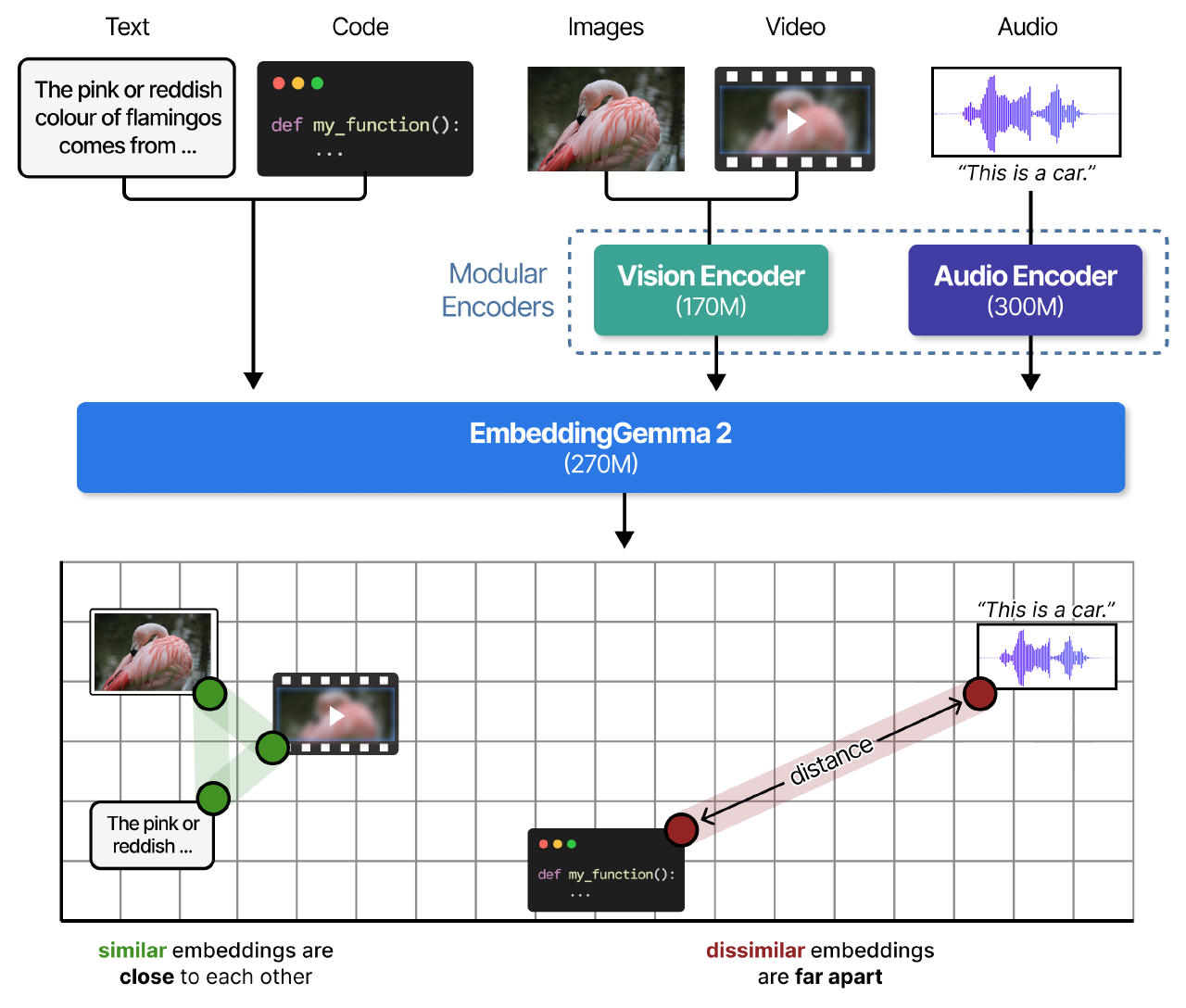
Google DeepMind Launches EmbeddingGemma 2 for On-Device Multimodal Search
The new 740M-parameter model can search text, code, images, video and audio on your phone or laptop without sending data to the cloud.