AI Agent Can Now Build Complete Games From Just a Few Words
A new framework called GAMEGO turns brief game ideas into full games by training agents on synthetic trajectories built from real-world game assets.
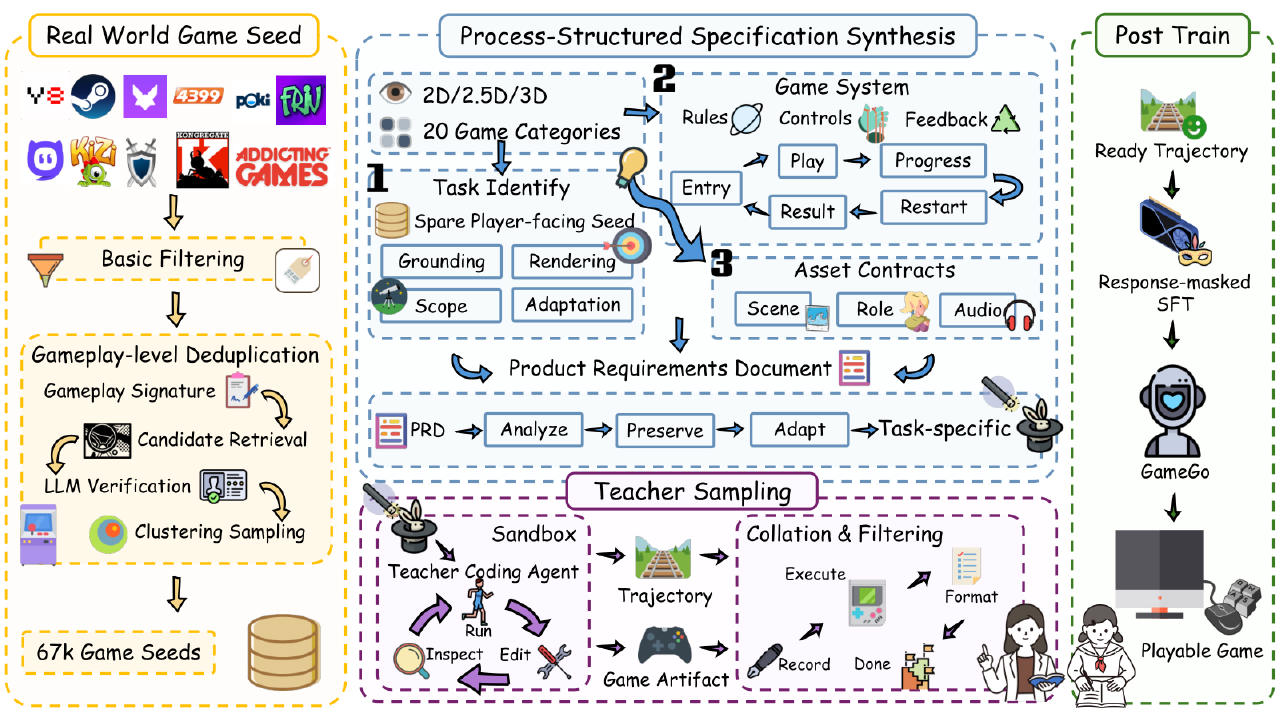
Researchers have released a new system that lets an AI coding agent turn a short sentence into a working video game — complete with mechanics, gameplay flow, and visuals.
The team, led by Haoyue Yang and including Jingyao Li, Zhengfan Wu, Jing Liu, Xuanle Zhao, and Kang Liu, published their work on arXiv in October 2026 under the name GAMEGO 1. The core idea is simple but powerful: instead of asking an AI to guess what a game should look like from a vague prompt, the system first expands that prompt into a full Product Requirements Document — the same kind of detailed blueprint used by professional game studios.
"Generating complex games directly from sparse user queries often forces coding agents to make underspecified assumptions," the authors write, "yielding incomplete mechanics, disconnected gameplay flows, and limited visual aesthetics" 1. That problem has blocked earlier efforts that relied on complex multi-turn workflows or focused only on static evaluation benchmarks rather than actual working games.
How It Works
GAMEGO bridges that gap with a two-step pipeline. First, it takes a brief game seed — something like "a platformer where you collect stars" — and transforms it into a comprehensive requirements document grounded in real game-development practices. The system uses a technique the researchers call task-specific dynamic compression, which packs as much useful detail as possible into the document while keeping the instructions clear and followable.
Then, a coding agent called GAMEGOCoder reads that document and builds the actual game. The result is a fully functional game rather than a half-finished prototype or a mockup that looks good on paper but breaks when you try to play it.
A Massive Synthetic Dataset
To train GAMEGOCoder, the researchers generated a large synthetic dataset named GameGoData, containing over 55,000 development trajectories across 2D, 2.5D, and 3D games 1. They also created GameGoBench, a benchmark with 124 diverse game queries designed to test how well an agent can handle different types of game requests.
On those benchmarks, GAMEGOCoder outperformed matched baselines and reached performance comparable to frontier models 1. The researchers said they will release all code, datasets, and models publicly.
The work sits at the intersection of large language model research and practical software engineering — showing that with the right training data and documentation pipeline, AI agents can tackle creative, open-ended tasks that previously seemed out of reach.
Key facts
- GAMEGO transforms brief game ideas into full Product Requirements Documents before coding begins
- The training dataset, GameGoData, contains over 55,000 development trajectories across 2D, 2.5D, and 3D games
- A new benchmark, GameGoBench, includes 124 diverse game queries
- GAMEGOCoder outperforms matched baselines and matches frontier model performance on gamedev benchmarks
- All code, datasets, and models will be made publicly available