Google DeepMind Launches EmbeddingGemma 2 for On-Device Multimodal Search
The new 740M-parameter model can search text, code, images, video and audio on your phone or laptop without sending data to the cloud.
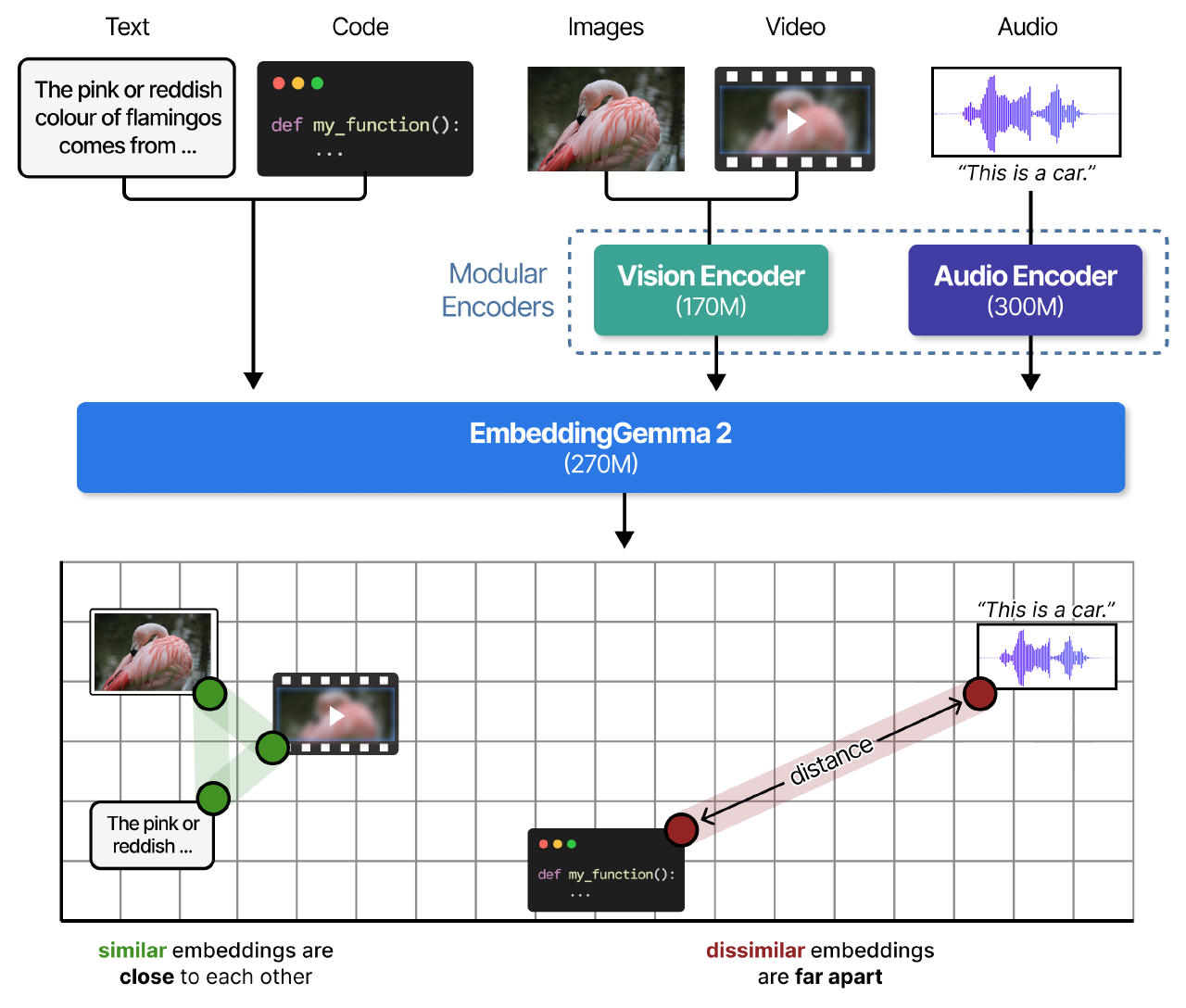
Google DeepMind has released EmbeddingGemma 2, an open-source model that turns text, code, images, video and audio into a single searchable format. It is built on the Gemma 4 architecture and licensed under the permissive Apache 2.0 license, meaning anyone can use it for commercial projects 1.
The model has 740 million parameters and can run on consumer devices. Google reports it uses about 191 megabytes of RAM for text-only work and 567 MB when using all modalities on a Pixel 11 Pro 1. That makes it one of the smallest multimodal embedding models available today.
One Space for Everything
An embedding model converts content like a document or photo into a list of numbers called a vector. Items with similar meaning end up close together, which makes them easy to search and compare. In a Retrieval Augmented Generation or RAG pipeline, these vectors let a large language model find fresh information it was not trained on 1.
EmbeddingGemma 2 maps all five content types into one shared 768-dimensional space. A text query can retrieve an image. A voice memo can find a video clip 3. The architecture is modular: developers can load only the parts they need, scaling from 270 million parameters for text and code up to 740 million for the full model 2.
Speed on Small Devices
Google designed the model for on-device use. Using a technique called quantization-aware training, weights are compressed to save memory without losing much accuracy. The company measured inference at 37.3 milliseconds per image on a MacBook M5 Pro GPU 1.
The model also supports Matryoshka Representation Learning, or MRL, which lets developers shrink output vectors from 768 dimensions down to 512, 256 or 128 3. Truncating to 128 dimensions can cut storage by up to six times, though Google recommends keeping 256 dimensions for multimodal work 1.
The context window holds 8,192 tokens — four times larger than version 1 — enough for roughly 29 images, 58 video frames or 5.5 minutes of audio 1.
Better at Code
On benchmark tests, EmbeddingGemma 2 scores leading results among models with fewer than one billion parameters. It earned 78.68 on MTEB Code, jumping nearly 10 points over version 1's 68.76 1. Multilingual text performance stayed strong at 61.36 on MTEB multilingual v2 .
Larger models still beat it on some tasks. Qwen3-VL-Embedding-2B, for example, reports higher scores but requires about 2.7 times more parameters and has no audio support 1.
Weights are already live on Hugging Face and Kaggle, with builds available through Ollama, llama.cpp and LiteRT 1. ML Kit support for Android with NPU acceleration is coming within weeks .
Key facts
- EmbeddingGemma 2 uses 740M parameters and runs in under 567MB RAM on a phone
- It maps text, code, images, video and audio into a single shared vector space
- Code retrieval accuracy jumped nearly 10 points compared to version 1
- Matryoshka Representation Learning lets vectors shrink to 128 dimensions, cutting storage six-fold
- Released under Apache 2.0, weights are on Hugging Face and Kaggle
Sources
- Google DeepMind Releases EmbeddingGemma 2, a 740M Open Multimodal Embedding Model Built on Gemma 4 — marktechpost.com
- EmbeddingGemma 2: The Developer Guide- Google Developers Blog
- EmbeddingGemma 2 is a best-in-class open model for natively multimodal ...
- EmbeddingGemma — Google DeepMind
- google/embeddinggemma-2 · Hugging Face
Related stories
 New modelsFLUX.3 Image Klein Arrives in Hugging Face DiffusersHerald of AI
FLUX.3 Image Klein Arrives in Hugging Face Diffusers
The 6-billion-parameter image-to-image model from Black Forest Labs is now available through the popular open-source library.
 PeopleSimon Willison Updates llm-gemini to Support New Gemini 4 Argon ModelHerald of AI
Simon Willison Updates llm-gemini to Support New Gemini 4 Argon Model
The developer behind the popular llm plugin adds Google's latest low-cost model, which promises strong performance at a fraction of rival prices — at least until December.
 New modelsGoogle's Gemini 4 Argon powers Chrome refactor, beats rivals in intelligence testsHerald of AI
Google's Gemini 4 Argon powers Chrome refactor, beats rivals in intelligence tests
The latest model helped Chrome engineers complete months of work in weeks while climbing the top of benchmark rankings.
 New modelsLiquid AI releases open-weight model built for fast on-device agentsHerald of AI
Liquid AI releases open-weight model built for fast on-device agents
The new 24-billion-parameter reasoning model runs 1.7 times faster than rivals on edge hardware.