ClawLoop AI agents that teach themselves to get better
A new training framework lets AI agents improve on their own without a stronger teacher model guiding every step.
A loop that feeds itself
Qwen is already one of the strongest open-source language models available, but a team of researchers including Hansi Yang at Alibaba has found a way to make it even better — without needing a more powerful model to coach it along. They call the approach ClawLoop, and it works by turning the agent's own mistakes into the fuel for its next round of improvement.
Most training pipelines for AI agents rely on an external teacher model. That stronger model creates the tasks, collects examples of how the student performs, and a human researcher checks the results. This setup has a hard ceiling: the student can never surpass the teacher, and progress depends on humans interpreting the data. ClawLoop removes both limits.
Three steps, repeated
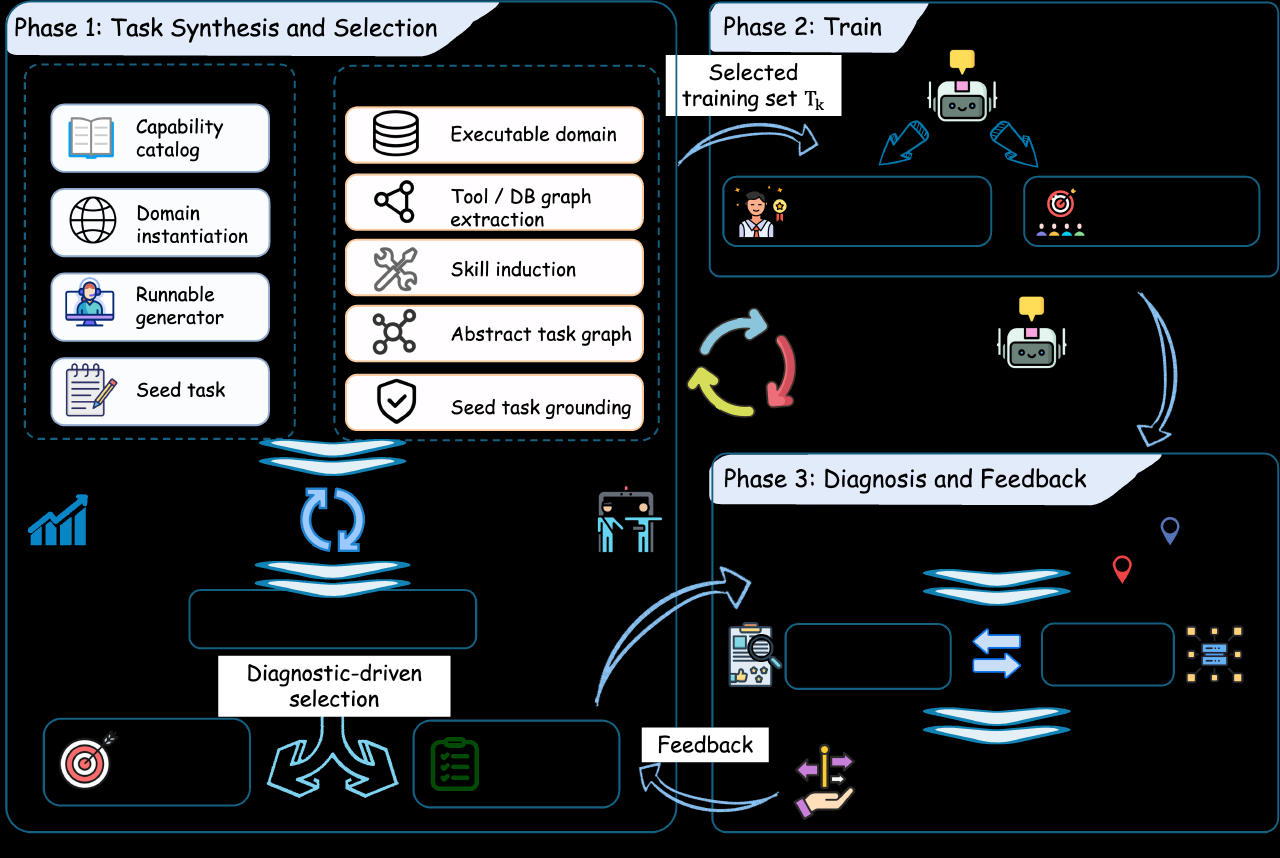
The system runs in a circle made of three phases. First, Task Synthesis creates a diverse pool of training challenges. It uses two different construction methods to make sure the tasks are varied, then filters them by increasing difficulty based on earlier failures and validates them with and without the agent itself 1.
Next, the Training phase updates the agent using two well-known techniques: supervised fine-tuning, where it learns from correct examples, and reinforcement learning, where it learns by trial and error with rewards for good behavior.
Finally, Diagnosis and Feedback watches how the agent actually performs during those training runs, writes up a report on what skills are still weak, and sends that report back to the first phase so the next batch of tasks targets those exact gaps.
Results that transfer
When the researchers tested ClawLoop using Qwen3.6-27B as the starting point, it improved consistently across three benchmarks: SkillsBench, Claw-Eval-Live, and ClawGym-Bench. But the most compelling finding came when they took the training data produced by the loop and used it to train smaller models — Qwen3.5-4B and Qwen3.5-9B. Those smaller models also improved across all the same benchmarks, showing that the training data was genuinely high quality and not just useful because of the large loop model 1.
Why it matters
The key insight is that ClawLoop does not need a bigger or smarter model to guide it. By feeding the agent's own diagnostic feedback into its own training loop, it can keep pushing past whatever its starting capabilities were. For open-source AI, where there is no single dominant "teacher" model, this kind of self-improving cycle could accelerate progress in ways that depend-free-of-proprietary advantage.
The paper was submitted to arXiv in October 2026 by researchers from Alibaba and other institutions.
Key facts
- ClawLoop replaces external teacher models with a self-sustaining three-phase training cycle
- Task Synthesis, Training, and Diagnosis feed into each other in a continuous loop
- Data generated by the loop improved smaller Qwen3.5 models, proving transferability
- The approach was tested on SkillsBench, Claw-Eval-Live, and ClawGym-Bench
Sources
Related stories
 New modelsLiquid AI releases open-weight model built for fast on-device agentsHerald of AI
Liquid AI releases open-weight model built for fast on-device agents
The new 24-billion-parameter reasoning model runs 1.7 times faster than rivals on edge hardware.
 How it worksAlibaba's QwenGyre Makes Training Long-Running AI Agents Much FasterHerald of AI
Alibaba's QwenGyre Makes Training Long-Running AI Agents Much Faster
A new elastic reinforcement learning system lets AI coding agents run for hours while still training efficiently on expensive GPU hardware.
 New modelsMicrosoft launches Decision-1 to compete in fast-growing AI decision model marketHerald of AI
Microsoft launches Decision-1 to compete in fast-growing AI decision model market
The new model aims to deliver fast, accurate decisions for routing and classification tasks, adding to a crowded field of specialized AI tools.