New attention method speeds up AI models with mathematical shortcuts
A paper introduces DoSA, which finds important tokens faster using bounds instead of full calculations.
The Problem With Sparse Attention
Modern AI models use an attention mechanism — a process that helps the model decide which parts of previous text matter most when generating each new word. In large language models, this attention step is one of the slowest parts of running the model, especially over long inputs.
Sparse attention methods try to fix this by only computing attention for a small subset of tokens — called keys — rather than all of them. But even these efficient methods still require scoring every key against every indexer head before picking the top candidates, which slows things down.
How DoSA Works
A new method called DoSA, or Dots Sparse Attention, takes a different approach. Instead of scoring everything fully, it uses mathematical bounds to figure out which tokens are likely worth a closer look — and which can be safely ignored.
The idea is that selecting the top K tokens does not always require knowing each candidate's exact score. A seed set of already-scored tokens gives a lower bound on the winning threshold. Then, two types of bounds help rule out tokens without full computation:
- Nonnegative head projections and joint residual bounds show the maximum positive contribution a token could have.
- Activation-informed aggregation bounds show how much a negative head could subtract.
Together, these bounds create a certificate that points to only the tokens still eligible for full scoring. Exact-score filtering then further reduces the amount of work needed for writing back results and making final selections.
Results
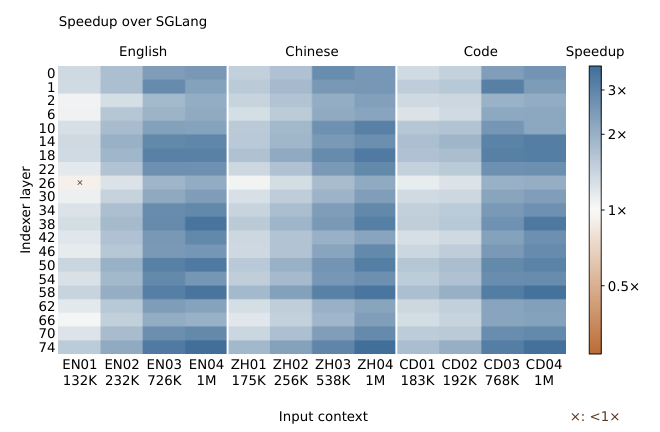
Testing was done on GPUs across English, Chinese, and code tasks. DoSA accelerated the full indexer by up to 2.74 times compared to SGLang and 1.69 times compared to LiteTopK 1.
End-to-end evaluations on GLM-5.2 showed up to a 1.94x speedup over SGLang and 1.50x over LiteTopK. Similar gains were seen on DeepSeek-V3.2 1.
Why It Matters
Faster inference means AI models can respond more quickly and run on less powerful hardware. That is especially important for applications that need low latency, like real-time chatbots or devices with limited compute. By reducing the amount of calculation needed in sparse attention — one of the most compute-heavy steps — DoSA makes it easier to run large models efficiently.
The paper also includes an analysis of how geometry and selection margins affect performance, giving insight into when and why the method works best.
The work was published on arXiv by Fanxu Meng and Taosong Fang in September 2026 1.
Key facts
- DoSA uses mathematical bounds to skip full scoring of irrelevant tokens in sparse attention
- GPU tests showed up to 2.74x indexer speedup over SGLang and 1.69x over LiteTopK
- End-to-end speedups of 1.94x (GLM-5.2) and 1.50x (DeepSeek-V3.2) were reported
- The method is lossless, meaning it preserves exact token selection
- Tests covered English, Chinese, and code workloads