How AI networks learn by building their own learning tools
MIT researchers show neural networks can self-organize their own learning rules, possibly mirroring how brains learn.
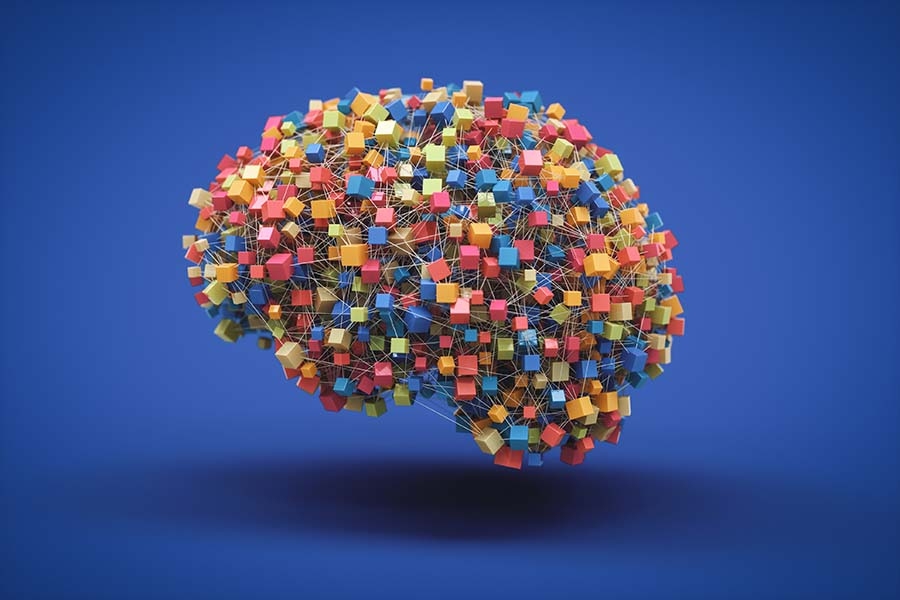
Building a brain that builds itself
Artificial neural networks—computer systems inspired by how brains work—usually rely on engineers to design every rule about how connections between parts should change during training. A new study from MIT shows that networks can instead build their own learning machinery, reorganizing themselves using only simple local rules.
The research was led by Qianli Liao and co-first authors Liu Ziyin and Yulu Gan at MIT's McGovern Institute for Brain Research and the K. Lisa Yang ICoN Center. Their findings were published on October 9 in the journal PNAS.
In most modern AI systems, developers decide exactly how connection strengths should shift as the network processes data and corrects its mistakes. That approach works well for engineering tasks, but it may tell us very little about how the actual brain learns, since brains have no external designer.
"The brain doesn't have an external designer or architect," Liao said. "The brain has to organize itself. And we need to know how simple rules are going to make the brain organize." 1
Simple rules, complex results
The MIT team started with a network of randomly connected, neuron-like units organized in multiple layers. Each unit followed the same basic rule: when two connected units activate at the same time, their connection strengthens. This mirrors the well-known neuroscience principle often summarized as "neurons that fire together wire together."
Through repeated interaction, small patterns called motifs began to self-assemble. These motifs served as building blocks for functional circuits capable of tasks like recognizing patterns and classifying images.
As learning progressed, the network adjusted its connections using an optimization strategy similar to gradient descent—a method in which connections are gradually tweaked in response to errors to improve performance over time. Unlike many modern AI systems that rely on back-propagation (a learning algorithm many neuroscientists consider unlikely to reflect how brains actually work), the MIT network achieved comparable performance without it. 1
Why self-organization matters
The researchers argue that a key measure of whether an artificial network can teach us about biology is its ability to organize itself—not just its connections, but the very machinery that adjusts those connections.
This has practical implications beyond theory. Tomaso Poggio, a senior researcher on the project, noted that finding a biological parallel to back-propagation could accelerate progress in both AI and neuroscience. "If the synaptic motifs we propose are, in fact, used by the brain to do what backpropagation does for artificial neural networks, then we will have a strong connection at the level of fundamental mechanisms between artificial and natural networks—between machines and brains," he said. 1
Understanding how brains self-organize could also inform the development of brain-computer interfaces, which aim to restore communication for patients who have lost language abilities or enable paralyzed individuals to control neuroprosthetic limbs. As Liao pointed out, such technologies cannot succeed without knowing the underlying rules of neuron-to-neuron interaction.
The study suggests that networks governed by simple, local rules may offer a more biologically realistic path toward both better AI and deeper understanding of how the brain learns.
Key facts
- MIT researchers built a neural network that organizes its own learning machinery using simple local rules
- The network self-assembled functional motifs without back-propagation, matching performance of traditionally designed systems
- Study published October 9, 2026 in PNAS by Qianli Liao, Liu Ziyin, and Yulu Gan at McGovern Institute
- Self-organizing networks may better model how the brain learns, with implications for brain-computer interfaces
Sources
- How artificial neural networks build their own learning machinery
- Machine learning — en.wikipedia.org
- Representation learning — en.wikipedia.org
- Deep learning — en.wikipedia.org
- Richard S. Sutton — en.wikipedia.org