Light-Powered AI Brain Processes Multiple Tasks at Once
Researchers created a holographic neural network that uses light instead of electricity to run several AI jobs simultaneously — no hardware changes needed.
One Brain, Many Jobs
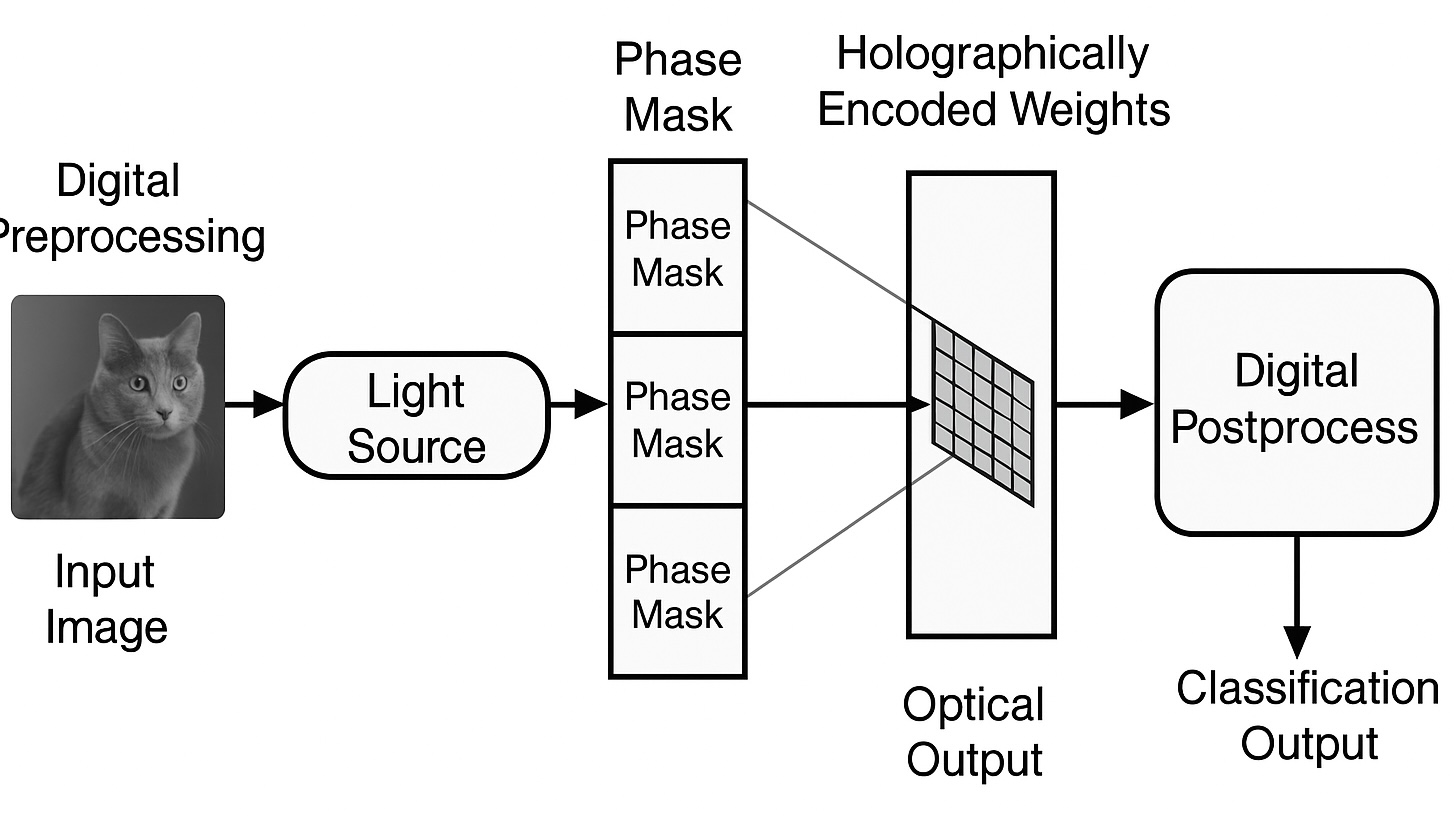
Scientists in China have built a new kind of artificial intelligence system that uses light to do several tasks at the same time. The system is called a holographic neural network (HNN), and it works by shaping light waves instead of relying on electronic circuits 1.
Traditional AI chips use electricity to process information, which consumes a lot of energy and can be slow when many tasks need to run together. Optical or photonic computing uses light to do the same jobs faster and with far less power 3.
The new HNN was developed by researchers at China Information Communication Technologies Group Corporation, along with teams at Peng Cheng Laboratory, Wuhan University, and Nanyang Technological University. Their findings were published in the journal Opto-Electronic Technology.
How It Works
The key to the system is a single device called a phase-only spatial light modulator, or SLM. This flat panel can control how light waves bend and spread as they pass through it. In the new design, the SLM does double duty: it both receives the input data and processes it using the physics of light diffraction 1.
Diffraction is what happens when light bends around obstacles or through tiny openings, creating patterns that carry information. The researchers used this effect to run multiple image recognition jobs at once — splitting and steering beams of light to different parts of the system without any moving parts 3.
Previous multi-task optical systems required either changing the color or polarization of the laser, or physically rearranging hardware between tasks. Both approaches are expensive and complicated 1. The new system avoids all of that.
Better Together
Training an optical neural network is tricky because the physical hardware must match the digital training process. The team used an end-to-end training method that accounts for how light actually behaves in the device, which helped simulation results closely match real-world performance 1.
They also introduced a new training trick: a task correlation factor. During training, the algorithm learns how much the different jobs overlap, and reduces interference between them. When two related tasks like recognizing two different digits were trained together, the multi-task system was actually more accurate than a system built for just one task 1.
The researchers demonstrated the system handling four different tasks at the same time while keeping classification accuracy around 90 percent 1.
Why It Matters
This work shows that optical AI hardware could one day replace or supplement electronic chips for certain types of work. Running multiple AI tasks in parallel with light could cut energy use dramatically while speeding up applications like medical imaging and pattern recognition 2.
As AI systems grow larger and more demanding, finding ways to process information with light instead of electricity could become an important part of the toolkit 3.
Key facts
- A single light-modulating device handles both input and computation in the new holographic neural network
- Multi-task optical AI can run four jobs at once with about 90 percent accuracy
- Training two related tasks together can actually improve accuracy compared to single-task training
- The system needs no mechanical parts or hardware reconfiguration to switch between tasks
Sources
- New holographic neural network uses light to perform multiple AI tasks at once — eurekalert.org
- Holographic Neural Network Achieves Multi-Task AI via Light-Based ... — radaislice.com
- New holographic neural network uses light to perform multiple AI tasks ... — brightsurf.com
- 2604.15364 Photonic AI: A Hybrid Diffractive Holographic Neural ...