Anthropic rebuilt its code system to handle 10x growth in daily changes
Anthropic replaced Git with a custom tool called Scion after its daily code merges jumped from 2,500 to over 30,000 in just four months.
An Extreme Growth Problem
Anthropic has redesigned how it manages its software code, replacing the widely used system Git with a custom-built alternative. The company says the change was driven by a massive spike in the rate at which its engineers submit code updates.
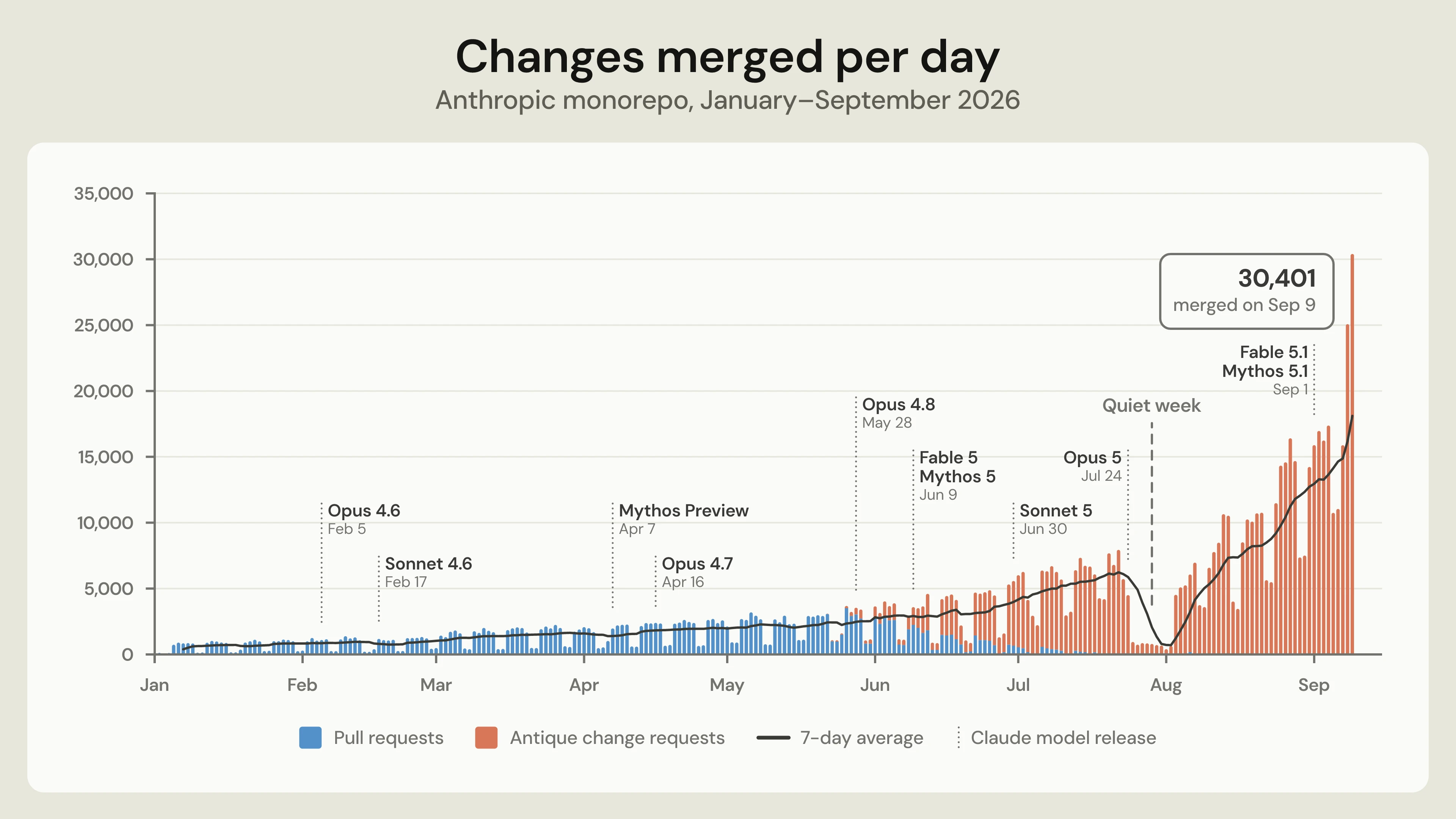
In May 2026, Anthropic merged around 2,500 code changes per day. By September, that number had climbed past 30,000 — more than ten times the earlier pace 1. The surge appears linked to the company's rapid development cycle around new model releases, though the exact timing of when models become available for internal use does not always match their public launch dates .
The numbers behind the code base are enormous. Anthropic says the history of its main branch alone is nearly 100 gigabytes, and a compressed working copy takes up more than 25 gigabytes 1. The company performs roughly 25 million code checkouts per day — a checkout means pulling the current version of all source files for testing or development — just for its continuous integration, or CI, systems that automatically test code whenever it changes . Without optimization, fetching those operations would generate over 600 petabytes of network traffic daily .
Building Scion and Antique
Anthropic assembled a seven-person team to build a replacement for Git. The new version control system is called Scion, and it works more like a centralized system such as Subversion rather than Git's distributed design 1. The company also introduced a new code review platform called Antique .
According to Simon Willison, who reported on the project, the entire migration from Git was completed in five months 1. Willison also noted that Claude helped analyze and modify a chart showing the growth in code merge rates across 2026 .
The engineering challenges are substantial. Moving from a distributed system like Git to a centralized one like Scion means rethinking how developers access, share, and track changes to code — especially at a scale where the data volumes are far beyond what most companies handle.
Using AI to Review Code
Anthropic also relies heavily on adversarial review, a practice where one AI model is tasked with finding flaws or weaknesses in another model's output 1. Willison shared that he has tried a similar approach in his own projects, often pitting different AI models against each other to stress-test results .
However, the company found that adversarial review can sometimes be too narrow in focus. Skilled engineers had to guide Claude to avoid over-engineering parts of the system in response to unlikely or hypothetical concerns 1. The lesson, according to Willison, is that human oversight remains essential even when AI assists in reviewing complex code .
The project shows how Fable-class and other advanced models are not only changing what Anthropic builds but also reshaping how the company engineers its own infrastructure.
Key facts
- Anthropic merged 2,500 code changes per day in May 2026, rising to over 30,000 by September.
- Anthropic's main branch code history is nearly 100 GB, with a compressed working copy over 25 GB.
- The company performs about 25 million code checkouts per day for CI alone.
- A seven-person team built the custom system Scion and completed the migration from Git in five months.
- Anthropic uses adversarial AI review but found human engineers still needed to prevent over-engineering.
Sources
Related stories
 How it worksHow the Claude Code team reinvented code review with AIHerald of AI
How the Claude Code team reinvented code review with AI
The team behind Anthropic's coding agent says Claude now catches most routine mistakes before a human ever looks at the code.
New AI plugin lets Claude design PCB boards inside KiCad 10
Konnect is a free open-source plugin that lets an AI assistant place components, route circuits and export manufacturing files directly inside KiCad.
 How it worksGraphicle brings fast code graphs and memory to coding agentsHerald of AI
Graphicle brings fast code graphs and memory to coding agents
A Rust rewrite of Graphify runs on your own machine and helps Claude and other AI coding assistants understand your project.
 PeopleSimon Willison builds two-player pong game that communicates via audio chirpsHerald of AI
Simon Willison builds two-player pong game that communicates via audio chirps
The AI educator used Claude Opus 5.5 to create a game where two phones exchange moves through sounds played through the microphone.