Technologies
JEPA
JEPA is an AI architecture developed by Meta and Yann LeCun that learns by predicting how the world changes, with a newer hierarchical version that plans across multiple levels of detail.
2 stories, first covered on Oct 10, 2026.
What is JEPA?
JEPA stands for Joint Embedding Predictive Architecture. It is an AI model design created by Meta AI and led by computer scientist Yann LeCun. Unlike most AI systems that predict raw pixels or words, JEPA works with abstract representations — compressed summaries of what it observes. It then tries to predict how those summaries will change over time. This approach was designed to be closer to how the human brain builds understanding of the world, rather than simply memorizing patterns.
The original version, called I-JEPA, was shared by Meta in mid-2023 and drew interest from researchers exploring more human-like AI. A later project called Lar-JEPA served as a testbed for organizing and running these kinds of predictive world models.
What is H-JEPA?
In October 2026, AMI Labs — a startup founded by Yann LeCun — released H-JEPA, the first research output from the company. H-JEPA stands for Hierarchical JEPA. It stacks multiple prediction layers on top of each other, allowing the AI to reason about both short-term actions and long-term goals at the same time. The full code and model weights were released as open source, making it freely available to other researchers.
AMI showed that this layered approach dramatically improves long-term planning in visual tasks. Instead of treating every moment the same way, the model can plan at different levels of abstraction, which brings it closer to how humans think ahead.
Why it matters
JEPA represents an effort to move AI past the pattern-matching approach that dominates today. By building internal predictions about how the world evolves, the system learns something more like a working understanding of cause and effect. H-JEPA takes that idea further by adding hierarchy, which is a key step toward AI that can plan ahead across time. The open-source release from AMI means the research community can now build on it directly.
Questions people ask
What does JEPA stand for?
JEPA stands for Joint Embedding Predictive Architecture. It is an AI design that learns by predicting changes in abstract representations of the world, rather than predicting raw pixels or words like most systems do.
Who created JEPA and what is AMI Labs?
JEPA was originally developed at Meta AI by Yann LeCun and his team. AMI Labs is a startup founded by LeCun, and it released H-JEPA as its first research project in October 2026.
How is H-JEPA different from the original JEPA?
H-JEPA adds a hierarchical structure with multiple stacked prediction layers. This allows the model to reason about short-term moves and long-term goals at the same time, which greatly improves its ability to plan in visual tasks.
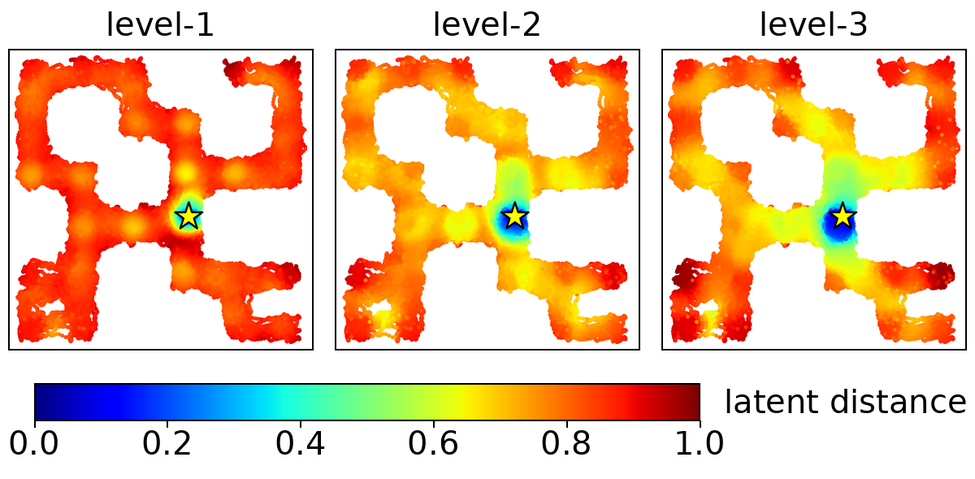 How it worksH-JEPA Lets AI Plan at Multiple Levels of AbstractionHerald of AIFigure: Zhang et al., arXiv:2610.06805, CC BY 4.0