Models
H-JEPA
H-JEPA is an AI model that learns to predict and plan at multiple levels of detail and time scales at the same time.
2 stories, first covered on Oct 10, 2026.
What H-JEPA Is
H-JEPA stands for Hierarchical Joint-Embedding Predictive Architecture. It is an advanced type of AI world model created by AMI, Yann LeCun's research startup. The model builds on an earlier idea called JEPA, which helps AI systems learn by predicting what happens next rather than just recognizing patterns.
The key difference with H-JEPA is that it stacks multiple prediction layers on top of each other. Each layer operates at a different level of detail and time scale. Lower levels handle short-term predictions about immediate actions, while higher levels reason about long-term goals and abstract plans. This lets the AI think about both quick moves and big-picture outcomes simultaneously.
The system uses a shared encoder that turns observations into compressed representations called embeddings. These embeddings preserve the essential patterns and dynamics of what the AI sees. There are three training approaches that can be used, all sharing the same core components.
How It Improves Planning
Traditional AI planning models often work in a single space and at one time scale. This limits how far ahead they can effectively reason. H-JEPA solves this by giving each level its own learned space where predictions happen. One level might predict seconds into the future, while another predicts minutes or longer.
The model has shown that this hierarchical approach dramatically improves long-horizon visual planning tasks. These are challenges where an AI must figure out a sequence of actions to reach a goal over an extended period. By organizing predictions across different levels, the system becomes more efficient at reasoning about complex, multi-step outcomes.
Current Status
AMI released H-JEPA as open-source research. The full code and model weights are publicly available. This means other researchers and developers can study how the system works and build upon it. The open release represents AMI's first major research output.
The technology has potential applications beyond games and simulations. It could help with remote control systems where devices need to understand their environment efficiently, encoding observations into compact forms that preserve important information for decision-making.
Questions people ask
What problem does H-JEPA solve?
H-JEPA solves the challenge of AI planning across different time scales. Regular AI models often struggle to balance short-term actions with long-term goals. H-JEPA handles both at once by organizing predictions into a hierarchy of levels.
How is H-JEPA different from earlier AI models?
Earlier models like standard JEPA predict in a single space at one time scale. H-JEPA adds multiple stacked layers, each working in its own learned space and predicting farther ahead. This lets it reason about immediate details and abstract long-term plans together.
Who created H-JEPA and is it available?
H-JEPA was created by AMI, the research startup founded by AI researcher Yann LeCun. It is fully open-source, with both the code and trained model weights publicly available for others to use and study.
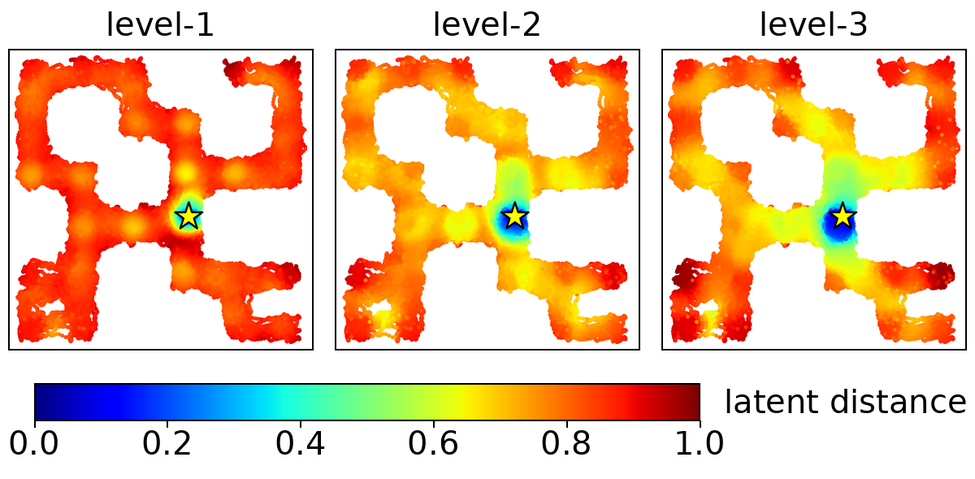 How it worksH-JEPA Lets AI Plan at Multiple Levels of AbstractionHerald of AIFigure: Zhang et al., arXiv:2610.06805, CC BY 4.0