All-transistor transformer learns to do in-context learning
A new physical circuit made entirely of transistors shows that hardware-level AI can perform the same kind of fast, on-the-fly learning as large language models.
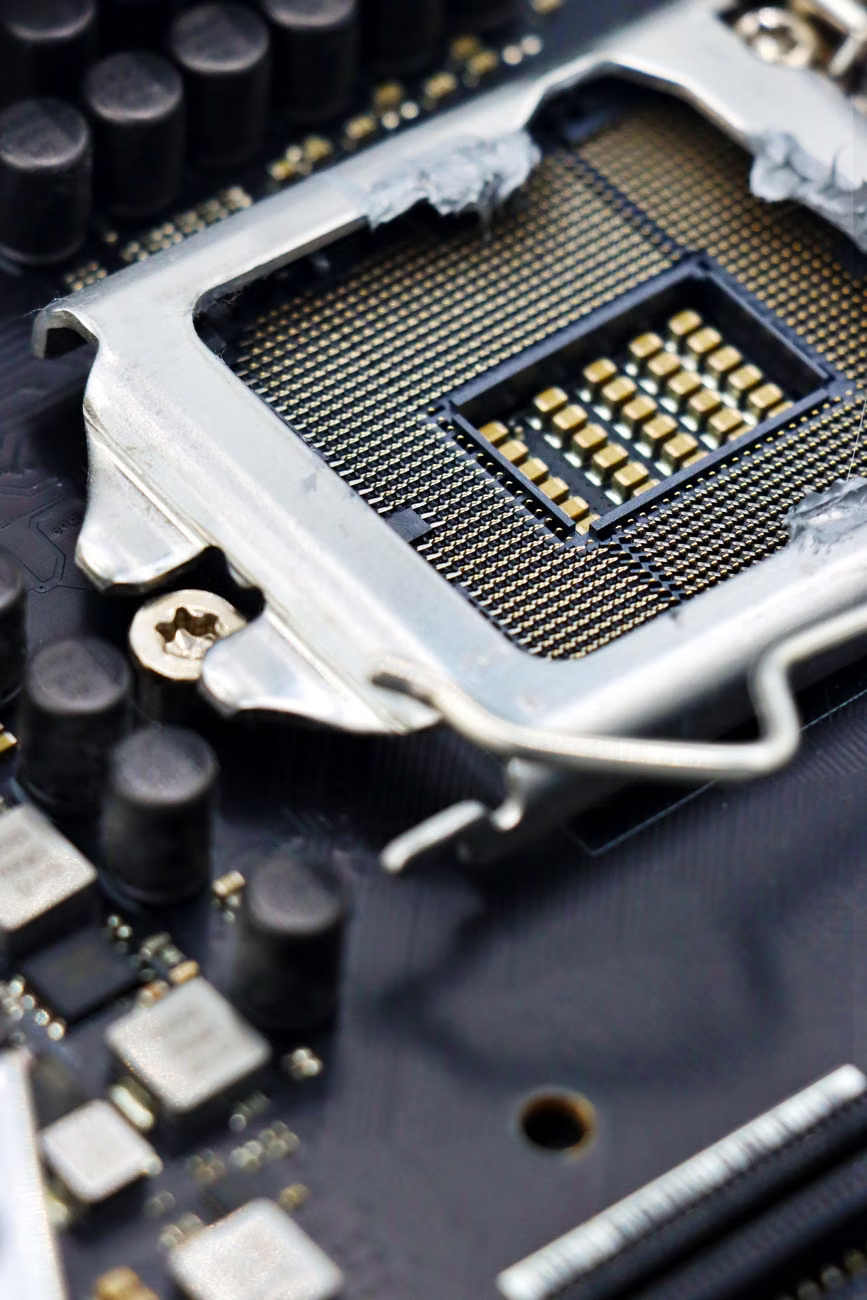
A transformer built from real circuit parts
A new research paper shows that a transformer — the architecture behind today's most powerful AI models — can be built using only physical electronic components instead of digital computer chips 1. The device is trained through a method called equilibrium propagation, which teaches a system by sending information in both directions through the circuit, rather than by running code on a GPU .
Most hardware-trained systems built this way have struggled with tasks that require connecting related pieces of information, like remembering a rule from earlier in a sentence and applying it later. Those tasks are easy for software transformers but hard for the simpler circuit designs used so far 1.
Solving the reverse-flow problem
The problem comes from how information flows through the hardware. In equilibrium propagation, a forward signal carries input data through the circuit, and a reverse signal carries error information back. In complex circuits that perform multiplication — which is needed for the attention mechanism at the heart of transformers — the reverse flow gets broken 1.
The researchers, Michael C. Abbott and Benjamin B. Machta, fixed this by adding special circuit elements that restore the two-way flow of information 1. They built an attention mechanism using the natural exponential current behavior of sub-threshold MOSFET devices, which are a type of transistor that operates at very low voltages .
Learning from context in a physical circuit
In simulations, the all-transistor circuit was trained to perform a simple in-context learning task — the ability to pick up a pattern from examples given in the prompt and apply it to a new question, without any weight updates 1. This is one of the most useful abilities of large language models.
The training only worked when the researchers used cross-entropy loss, not the more common mean squared error 1. To generate the "nudges" the algorithm needed for this loss function, they designed a novel floating circuit element based on the same MOSFET sub-circuit used for softmax .
The resistors in the circuit were trained using the Lion optimiser, which can be implemented using just one capacitor per parameter to store a local memory of past gradient estimates — an important detail for making the whole thing work in physical hardware 1.
Why it matters
The result does not yet beat software transformers on large benchmarks, but it proves a principle: the kinds of reasoning and associative learning that make transformers useful can be reproduced in pure analog hardware 1. If researchers can scale this approach, it could one day lead to AI devices that learn and adapt on-chip, without constantly sending data back to a server.
The paper was posted to arXiv on 8 October 2026 1.
Key facts
- The transformer was built entirely from transistors using equilibrium propagation, a bi-directional learning method
- Adding special circuit elements restored the reverse information flow that multiplication normally breaks
- The circuit successfully performed in-context learning in simulations using cross-entropy loss
- The Lion optimizer was used, storing gradient history with one capacitor per parameter
- The work was posted to arXiv on 8 October 2026 by Abbott and Machta
Sources
Related stories
 How it worksTurboMamba combines Mamba and Transformer for faster, smarter language modelsHerald of AI
TurboMamba combines Mamba and Transformer for faster, smarter language models
A new hybrid architecture boosts speed and accuracy by mixing two kinds of AI designs.