AI Researchers Let GPT Drive a Car to In-N-Out
Three engineers at Axiom put OpenAI's text model at the wheel of a Toyota Corolla — and it actually worked.
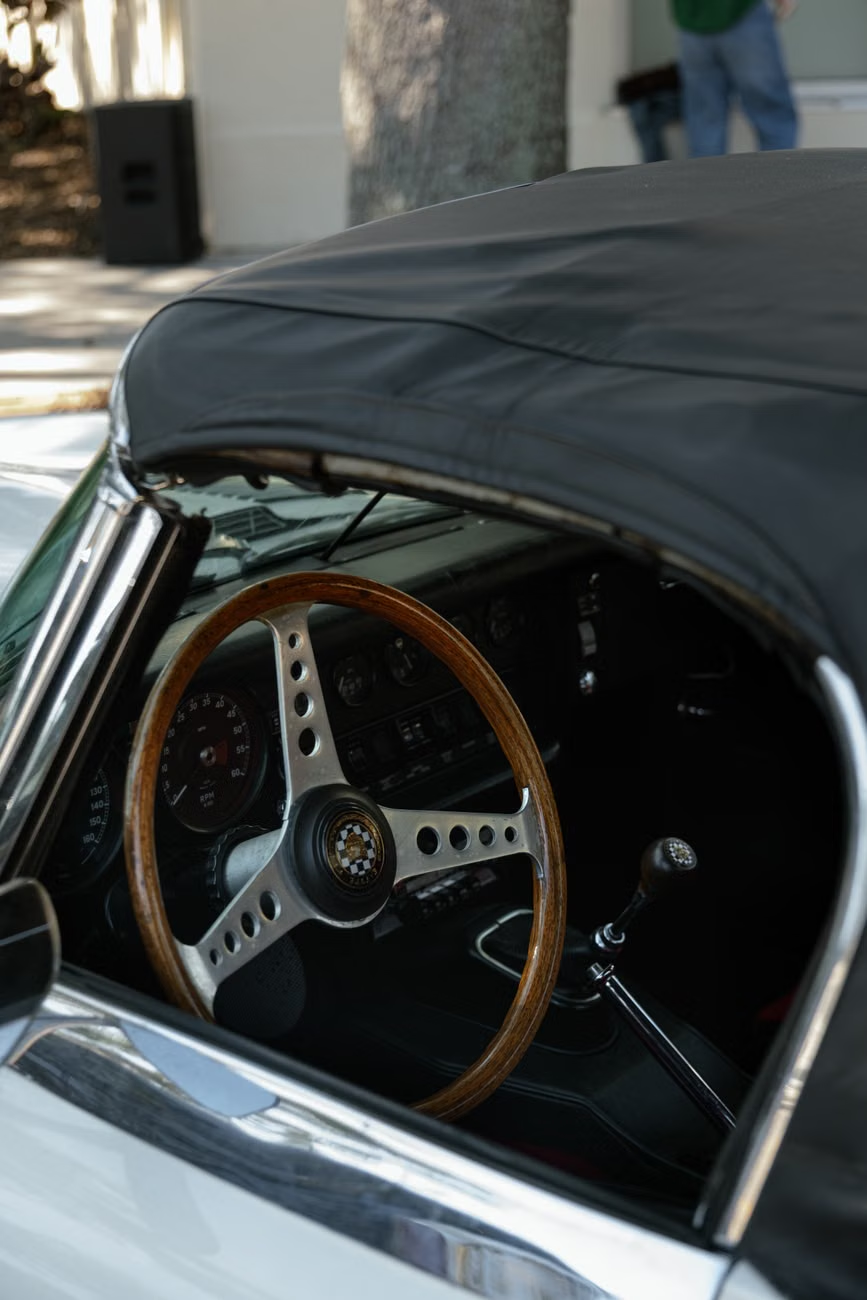
The Drive-Thru Experiment
Aditya Ramabadran, Simon Mahns, and Tobias Gessler — three AI engineers at the startup Axiom — had a hungry Sunday afternoon. Instead of driving themselves to OpenAI's nearby GPT-6 Astra lab for In-N-Out, they wired the chat model up to the car's steering and let it navigate the Bay Area streets.
They mounted cameras on the windshield, connected them to a laptop running Astra, and linked the output to the Corolla's power steering. A safety driver hovered a foot above the brake. The model, designed for text and code, not physics, guided the car slowly but steadily to the drive-thru window.
Why It Matters
Self-driving cars aren't new. Tesla and Waymo already run fleets on purpose-built algorithms. What the Axiom team showed is different: a general-purpose model — one that's never seen a car or a road — can learn to drive by connecting its visual input to physical controls, on the fly, with no prior training for the task.
"Maybe AGI is here after all," said one of the researchers. Artificial general intelligence, the goal of machines matching human reasoning, remains a distant benchmark — but this was a concrete step toward embodied AI, where models interact with the physical world rather than just simulating it.
The Benchmark
After the burger run, the trio built a formal test called DrivingBench. They set up a simple parking-lot course and put four models at the wheel: Astra, Claude Fable 5.1, Grok, and a baseline.
Only Astra completed the course — and very slowly. Claude got 45 percent of the way. Grok managed just 11 percent. The results suggest that scaling up multimodal training (images, video, 3D simulations) gives models a rough physical intuition, but they still fumble at real-world execution.
Learning by Doing
The real surprise wasn't that Astra drove — it was that the models adapted as they went. "The models really did seem to be adjusting or in-context learning based on their mistakes," Ramabadran said. Rather than following a pre-programmed rule set, Astra refined its steering inputs after each error, building a crude but working understanding of cause and effect.
The team warns that this capability is fragile. A text model behind the wheel of a two-ton car is a high-stakes experiment — one that works in a parking lot but might not survive a real highway. Still, the implication is clear: as multimodal models get better at reasoning about the physical world, they may find their way into robotics, autonomous systems, and other areas where perception meets action.
For now, the researchers are content with their In-N-Out. The burger tasted fine. The drive was slower than any human would manage, but it was undeniably their own.
Key facts
- Three Axiom engineers used GPT-6 Astra to drive a Toyota Corolla to In-N-Out in the Bay Area
- A safety driver was present throughout the experiment
- DrivingBench benchmark: only Astra completed the parking-lot course; Claude got 45%, Grok 11%
- Models learned by adapting to errors in real time, not from pre-trained driving data
- The capability comes from multimodal training, not task-specific instruction
Sources
- These Researchers Made AI Drive a Toyota Corolla to Get In-N-Out — wired.com
Related stories
 New modelsOpenAI Brings GPT-Rosalind to Academic Research Labs Through New Free PlanHerald of AI
OpenAI Brings GPT-Rosalind to Academic Research Labs Through New Free Plan
The Rosalind Academic Plan offers eligible labs up to 30 free seats to access OpenAI's life sciences model for up to 12 months.
 PeopleSimon Willison releases web-edit for browser-based file editingHerald of AIPaul Downey from Berkhamsted, UK, CC BY 2.0, via Wikimedia Commons
Simon Willison releases web-edit for browser-based file editing
His new tool lets you edit files in a folder straight from your browser, with help from Claude Opus 5.5.
 PeopleSimon Willison Updates llm-gemini to Support New Gemini 4 Argon ModelHerald of AI
Simon Willison Updates llm-gemini to Support New Gemini 4 Argon Model
The developer behind the popular llm plugin adds Google's latest low-cost model, which promises strong performance at a fraction of rival prices — at least until December.
 New modelsEU's AI adoption shifts to agentic tools, report findsHerald of AI
EU's AI adoption shifts to agentic tools, report finds
OpenAI data shows businesses are moving beyond chat to let AI plan and complete tasks, though growth remains uneven across the bloc.