T0 A 256M open-weights model redefines time-series forecasting
The Forecasting Company released T0, a small but powerful foundation model that produces probabilistic forecasts for everything from electricity demand to drug reimbursements.
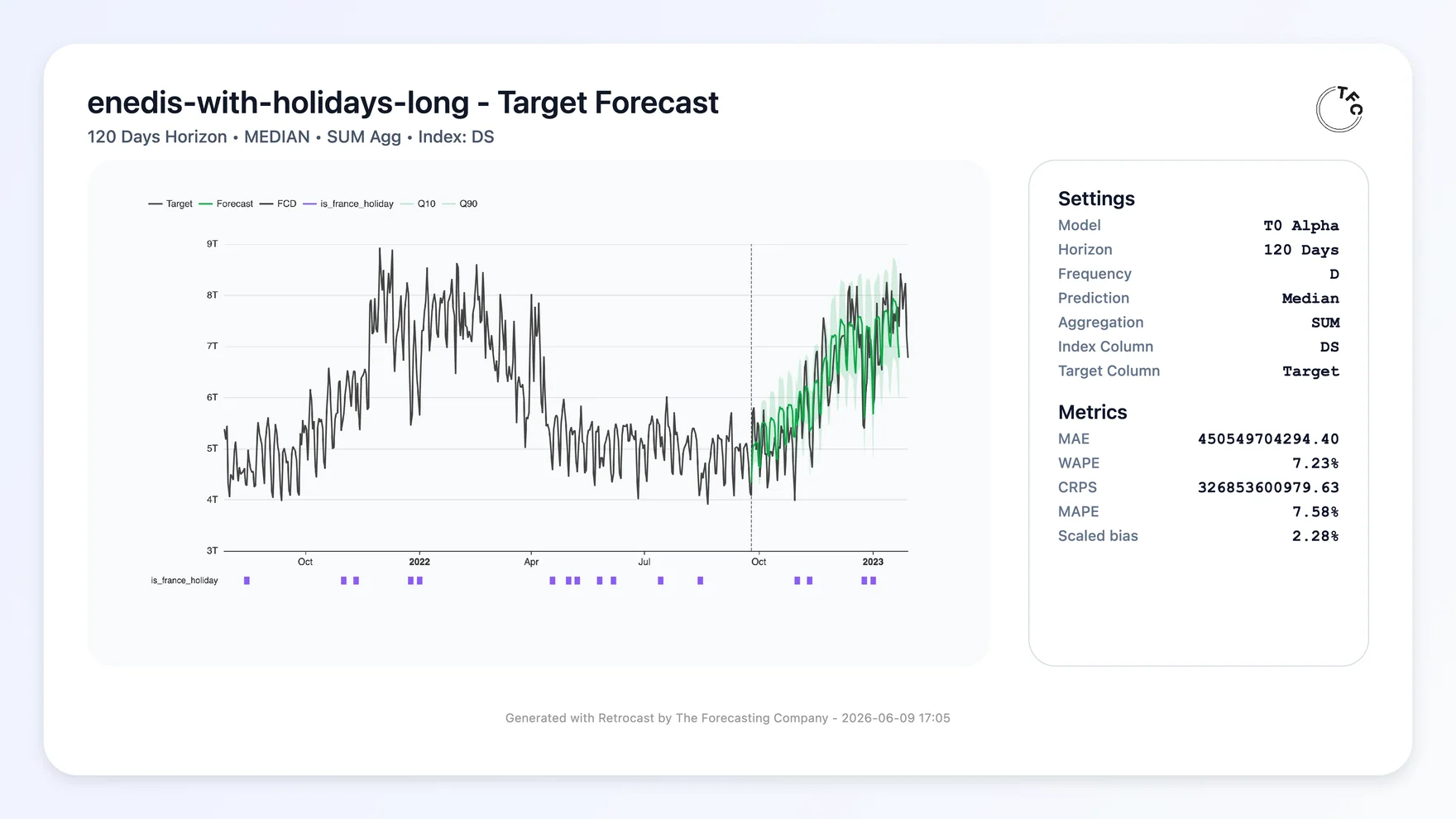
The Forecasting Company has released T0, an open-weights foundation model for time-series forecasting that at just 256 million parameters matches or beats larger specialized models across a range of benchmarks. Three variants — t0-alpha, t0-beta and t0-gamma — are publicly available on Hugging Face and download without any authentication 1.
Unlike many generative AI models that produce text or images, T0 is built for a very different task: predicting what comes next in a sequence of numbers. It produces probabilistic forecasts, meaning it outputs a range of likely outcomes rather than a single guess. This makes it useful for anything from electricity demand to retail sales.
How it works
T0 takes historical data as input — called the "context" — and can also accept covariates, which are extra signals the model knows in advance. Calendar features, planned promotions, weather forecasts and similar information can be fed in as future covariates, helping the model make smarter predictions 1.
The model supports several preprocessing options that improve accuracy. These include trimming missing values at the start of a series, averaging the forecast with a mirrored version of the negated series, clipping negative predictions to zero for data that cannot be negative, and snapping integer-valued series to whole numbers 1.
Users can run T0 on Apple Silicon through the MLX runtime, and the code is available on GitHub under an open license 1.
Real-world tests
The developers demonstrated T0 on several public datasets. It was used to forecast French national electricity demand using data from Enedis, and monthly drug reimbursements from the French national health insurance system. A more complex example involved European day-ahead electricity prices across four bidding zones, where the model used load, renewable energy output, holiday schedules and weather data as covariates 1.
The quickstart requires only a few lines of code. Users install the package, load the model, pass in a context of past observations and request predictions for a chosen horizon, and receive quantile forecasts that show the range of likely outcomes 1.
Why size matters
At 256 million parameters, T0 is remarkably compact compared to large language models that can have hundreds of billions. This smaller footprint means it runs faster and on cheaper hardware while still delivering competitive results. The model was designed from the ground up as a forecasting foundation model, not adapted from a language model 1.
The release comes as the AI community increasingly explores how foundation model techniques can be applied beyond text and images. T0 shows that the same principles — training on diverse data, using attention mechanisms, and offering probabilistic outputs — can work effectively for numerical prediction tasks as well.
Those interested can find the code and model weights on the project's GitHub page 1.
Key facts
- T0 is a 256M parameter open-weights time-series forecasting model from The Forecasting Company
- Three variants — t0-alpha, t0-beta and t0-gamma — are freely downloadable without authentication
- The model produces probabilistic forecasts and can use known-future covariates like weather and calendar data
- It was tested on French electricity demand, drug reimbursements and European day-ahead electricity prices
- T0 supports the MLX runtime for Apple Silicon and includes options like symmetric averaging and integer snapping